Glass Bottle Manufacturing Process

In China, the manufacturing of glass bottles has a history of several thousand years. At first, people could just make some simple bottles and jars by hand, now we have widely used fully automatic machines to produce a huge variety of different shapes and sizes of glass containers.

1. The Raw Materials

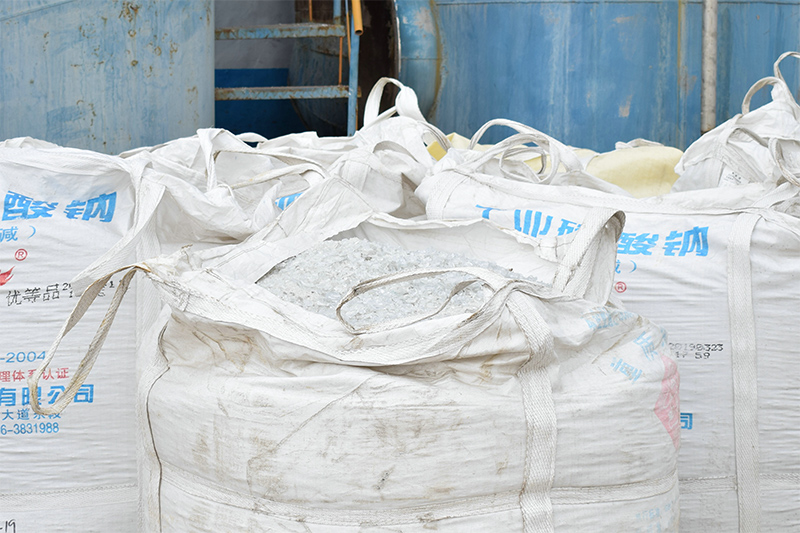
At Henkaul, We produce Extra White Glass(likes crystal ) and Opal Glass( milk white and opaque ). These are, indeed, they are soda lime silica glass. The raw materials applied in the process are:
quartz sand
limestone
sodium carbonate
recycled cullet
chemical additive

The quartz sand is the main raw material, limestone provides stability and sodium carbonate lowers the melting point,.as well as chemical additives improve transparency and surface finish. As we work towards becoming more sustainable, we also use ecycled cullet to help save on the use of raw materials and energy.
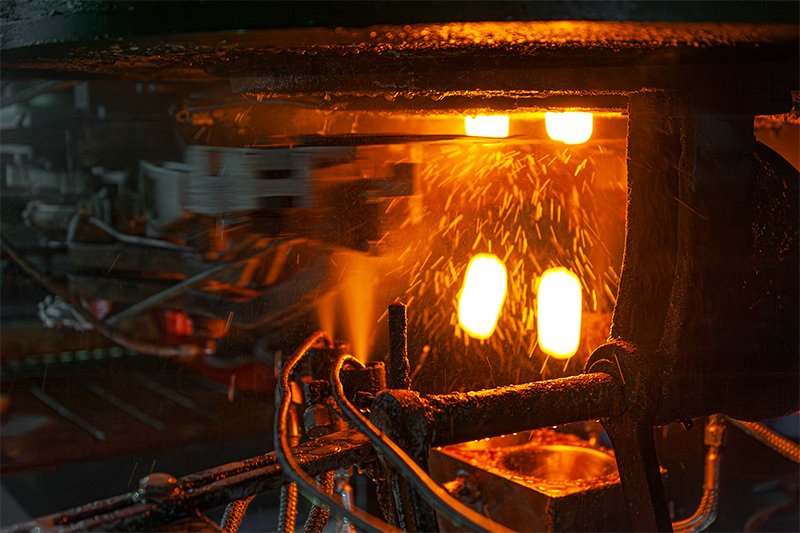
2. Melting

The melting process can be divided into three main steps:
First, the batch is placed in a furnace that reaches temperatures of’ up to 1,600. There, the solid components slowly melt into a homogeneous mass.
In the next step, purification begins. This means that the gases are expelled, which is essential for producing a higher quality glass.
During the final phase, the mass is cooled down until it reaches the right temperature needed for shaping.

3. Shaping

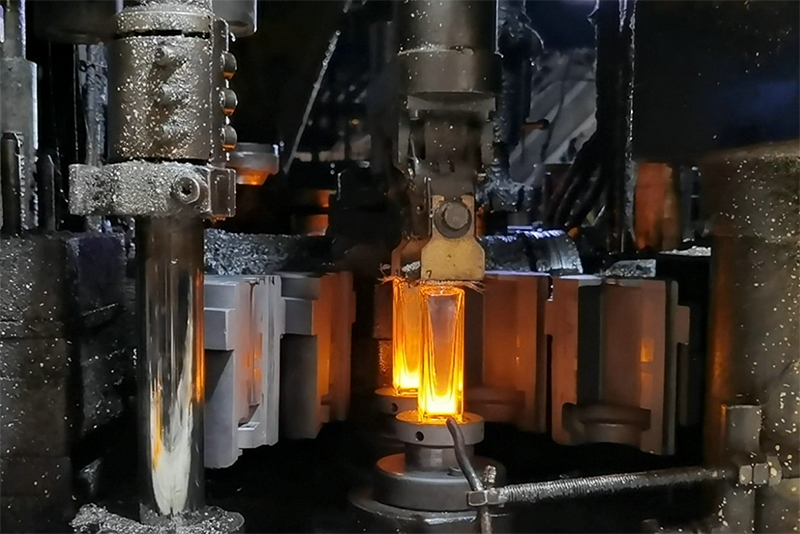
The forming process begins in the feeder. Here, gobs of glass are cut off, which are then formed into the required shape using the I.S. forming machine. Using the blow-blow or press-blow process the machine works very quickly to configure the viscous liquid into finished products. The formed glass bottles and jars are then transported on a conveyor belt for cooling.
Blow and blow process:

This method is utilised especially for narrow mouth glass bottles, such as glass perfume bottles, diffuser bottles, dropper bottles.
Press and blow process:

This method is applied for wide mouth glass containers, such as cosmetic glass jars, screw-top glass candle jars.

4. Cooling

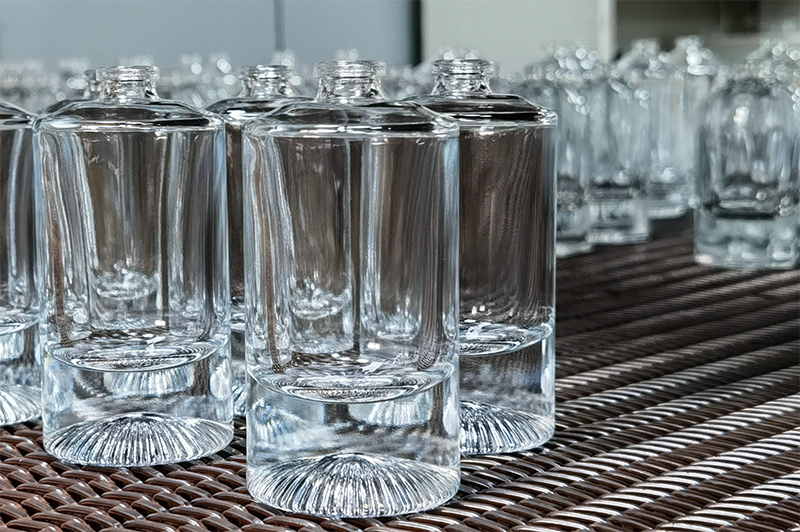
Annealing describes the process in which the glass bottles and jars are cooled dowm after the moulding process. This is achieved in a heated furnace called Lehr, where the glass is slowly cooled down to avoid breakage or damages. The temperatures of this cooling area are between 600 °C and 450 C. So the process must be carefully managed and controlled to ensure that the finished containers are as strong as possible.
Contral microvariation
Reduce hairline crack of bottle mouth

5. Inspection

Quality control starts in the forming section. Through manual visual inspection and auxiliary equipment, 100% inspection of glass bottles is conducted from Hot End to Cold End.
Contral microvariation
Reduce hairline crack of bottle mouth

6. Packing

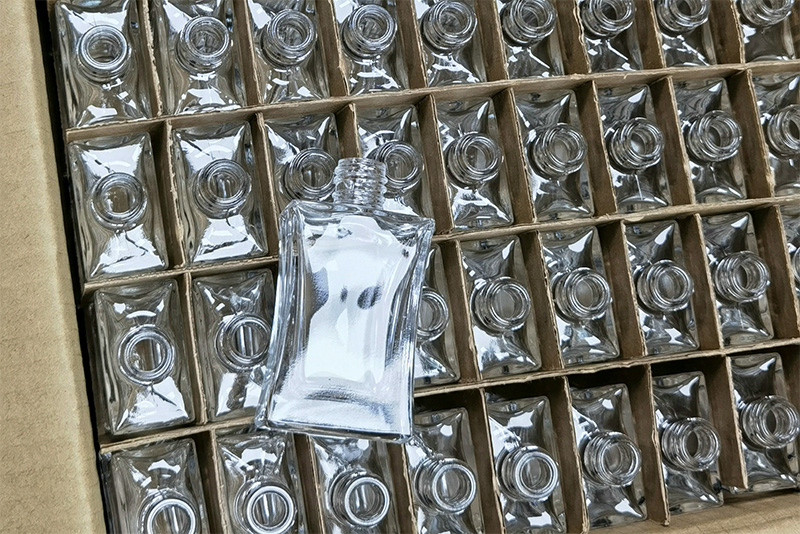
Glass is a fragile material, which makes packing our products all the more important. To ensure our glass products reach our customers in exceptional condition, we diligently pack them so we can be confident that the bottles and jars are absolutely safe for transport.
Our two main recyclable packing:
Carton with partition
Pallet with Partition or pallet + carton with partition

Contact Us Now!

If you have any questions or inquiries, Our sales department supports you with all questions about our products and services. We are happy to hear from you!

Email: sales@henkaul.com           

Whatsapp: +86 187-9542-5696 
    Henkaul manufactures and supplies top quality glass containers to customers in the fragrance and cosmetic industry.

    CONTACT US

    Add.: No.112, Meiyuan Road, Jiawang, Xuzhou, Jiangsu, China
     +86 516 87709182
     +86 516 87708062
     info@henkaul.com
    Mon - Fri: 9:00 am - 5:30 pm (BJT)

    NEWSLETTER

    Discover all the news in advance. Sign up for the newsletter.

      Henkaul 2025. All Rights Reserved

      Language

      en_uszh_cn

      Language